“It’s the unanswered questions that makes it worth getting up in the morning.”
― Stephen King, Wizard and Glass

Happy 2026! Is it just me or does everyone have a running list of questions that randomly pop into your head that never get answered? Sometimes these questions go unanswered because I just don’t search out the answer, some because there may not be an easy answer, or some they are so random I never type in Google for fear of judgment. The great lyricist Ghostface Killah once asked, “Why is the sky blue? Why is water wet? Why did Judas rat to the Romans while Jesus slept?” Those first two questions are easy to answer…the third not so much. Just so you know, the sky is blue because Earth’s atmosphere scatters shorter blue wavelengths of sunlight more than other colors, and water feels wet because liquids adhere to our skin and trigger nerve receptors that detect moisture and pressure.
But why did Judas rat to the Romans while Jesus slept? Christians and scholars have long disagreed on how to understand Judas: many view him as a villain who freely chose betrayal out of greed and moral failure (supported by Matthew 26:14–15 and John 12:4–6), while others see him as a tragic figure whose remorse (Matthew 27:3–5) suggests regret but an inability to seek restoration, and still others argue he was a necessary instrument in God’s redemptive plan, since Jesus’s arrest and crucifixion occurred “according to the definite plan and foreknowledge of God” (Acts 2:23). Yet Scripture holds these views in tension: Judas is never excused. Jesus declares “woe to that man who betrays the Son of Man” (Matthew 26:24) while simultaneously affirming that his actions fulfilled Scripture (Psalm 41:9; Acts 1:16), meaning the Bible presents Judas as morally responsible for his choice even as God sovereignly brought redemption through it.
And maybe that’s what really lingers…not Judas specifically, but the tension of questions that refuse to land cleanly on one side or the other. Some things just don’t wrap up with a bow, and maybe they aren’t meant to. Which brings me to the first question currently living rent-free in my head: Why does it feel like there are no modern-day philosophers anymore? We’ve got experts, influencers, pundits, and an endless supply of people yelling confidently into microphones, but very few folks whose job seems to be slowing things down, asking uncomfortable questions, and admitting they don’t have all the answers. Maybe philosophers are still out there and we just rebranded them as podcasters… or maybe we scroll past wisdom now because it doesn’t come with a hot take or a thumbnail.
Question 2: Why do we always want something more the moment it’s off-limits? Tell a kid not to touch the stove and suddenly it’s the most fascinating object in the house. Tell me I should cut back on any food…the same thing happens. There’s something about restriction that flips a switch in our brain, turning mild interest into full-blown obsession. Maybe it’s human nature. Maybe it’s pride. Or maybe it’s just that nothing sounds better than the thing you’ve already decided you don’t need…right up until you’re told you can’t have it.
Question 3: Have we confused having an opinion with having wisdom? It feels that way sometimes. Opinions are everywhere now! Quick, confident, and usually delivered at full volume. They’re easy to form, easy to share, and even easier to defend, especially when they fit neatly into a caption or a comment box. Wisdom, on the other hand, takes time. It requires listening, sitting with uncertainty, and occasionally admitting, “I might be wrong.” Somewhere along the way, we started rewarding certainty more than curiosity and confidence more than understanding. And while opinions make for good engagement, wisdom tends to speak more quietly—often after thinking things through, and usually without the need to win the argument.
Question 4: Why do we allow so many people to make predictions but never hold them accountable after the fact? Every year we’re handed bold forecasts about sports, markets, politics, the economy, technology, and just about everything else. These get delivered with absolute confidence and usually backed by a graphic, a hot take, or a highlight clip. When a prediction hits, the person gets crowned a genius. When it misses… we quietly move on to the next forecast like nothing ever happened. There’s rarely a follow-up, no scoreboard, and no moment where someone says, “Hey, remember when you guaranteed this would happen?” Maybe it’s because accountability doesn’t trend very well, or because certainty is more entertaining than accuracy. Or maybe we just prefer confident predictions to the uncomfortable reality that even the smartest people are guessing more often than they’d like to admit.
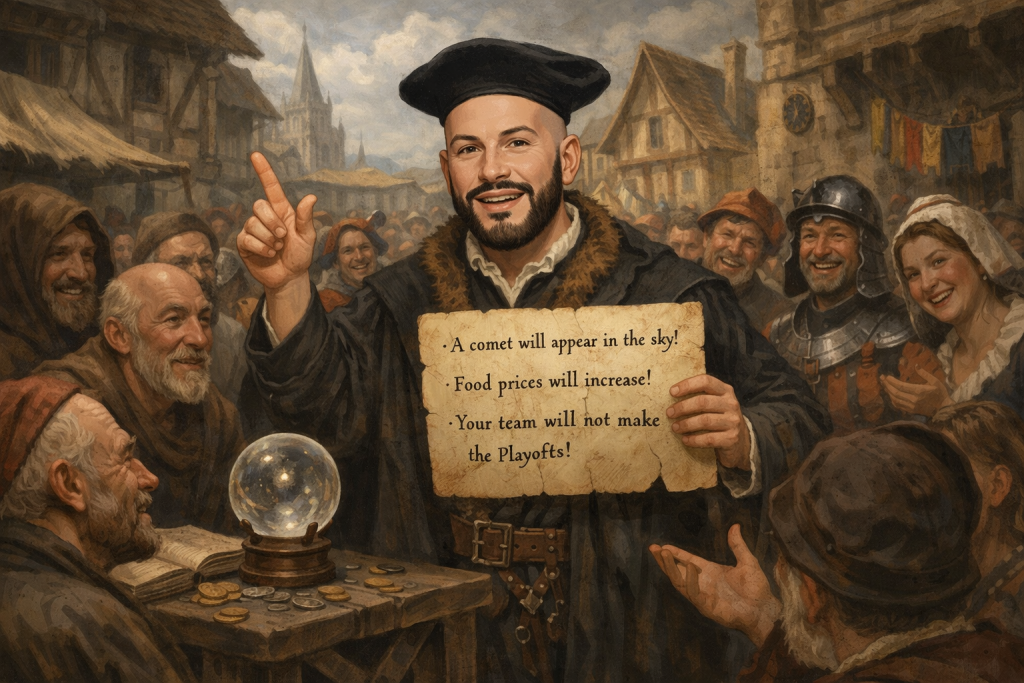
Question 5: Why have you made it this far on the blog? At this point, I assume one of three things has happened: you’re genuinely enjoying this, you got distracted and forgot to click away, or you’re the kind of person who finishes things simply because you’ve already invested the time…something I deeply respect. Either way, I appreciate you sticking around while I’ve wandered through half-baked thoughts, big questions, and the occasional mental detour. If you’ve got a question that’s been bouncing around in your own head, drop it in the comments here or on the Facebook post…I’d genuinely love to hear it. And since you’re still here, it feels like a good moment to pivot from the questions bouncing around in my head to the books and articles that help me make sense of them, because when I don’t have the answers (which is often)…I usually end up looking for them on a reading list from the past.
- Article: ‘Like hitting a lotto ticket.’ Why sports memorabilia collectors pursue chase cards
- Article: Wise County government chief prepares to depart as county budget woes continue
- Article: Collectors unite at Kingsport trading card event this weekend
- Article: How to Train Through Bad Weather
- Article: Get 1% Better Every Day: The Kaizen Way to Self-Improvement