I recently started rewatching Game of Thrones after finishing the first season of A Knight of the Seven Kingdoms. At the same time, nearly every article, podcast, and book I’ve been consuming has circled back to the same phrase: “AI Winter.”
So I decided to experiment.
What would happen if those two currents collided — medieval political intrigue and modern economic transformation? In less than five minutes, I had a 1,500-word short story and original illustrations. The speed was impressive. The implications were more interesting.
Is it an instant classic? No. Is George R.R. Martin losing sleep over a short story on a non-monetized blog? Also no. But that isn’t the point.
The first snow came early to Greyfen—thin as ash, silent as a thought you didn’t mean to have. It dusted the battlements, clung to the black pines beyond the wall, and softened the road that wound down to the river like a pale ribbon. Below, barges nosed through slush and reeds, their lanterns wavering in the wind as if undecided whether to be brave.
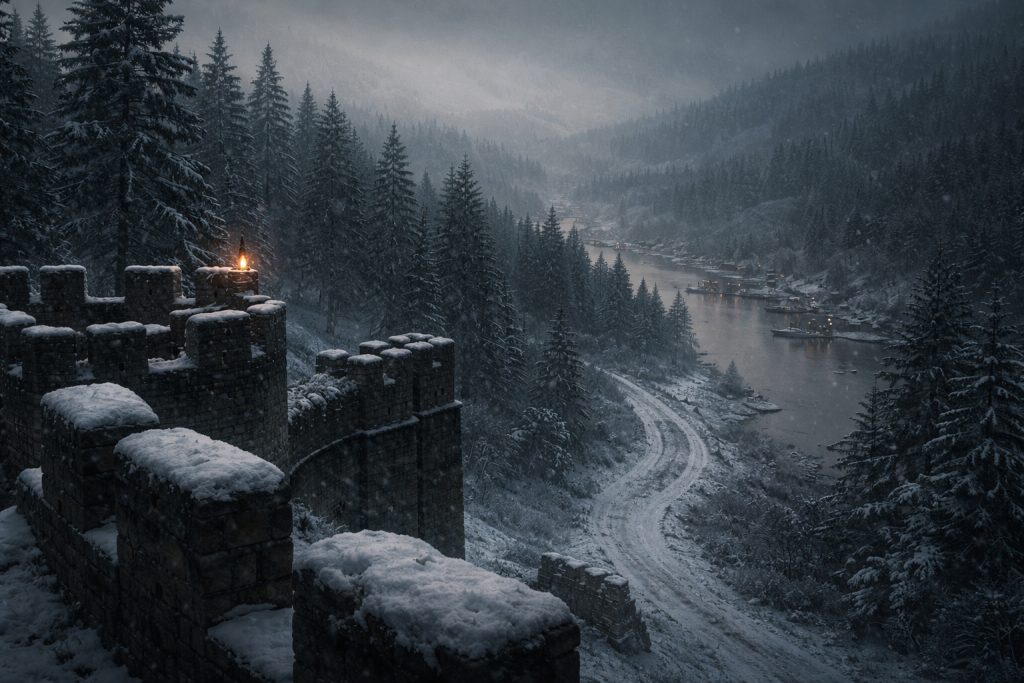
Lord Halric Vayne stood beneath the gatehouse arch, cloak pinned with a wolf’s tooth, and watched the river traffic as though it were an army.
“They’ll tell you it’s a mild season,” he said, voice flat. “They always do.”
Joryn—his son, his heir—didn’t answer at first. He listened. There was a sound behind the stone: a faint ticking, a low metallic breath. It came from deeper within the keep, from the hall they had sealed and guarded, the hall with no windows where the air always smelled of oil and hot metal.
The Cognition Engine was awake.
A messenger in House Vayne’s grey came up the steps and bowed low. “A raven from Stoneharbor, my lord. And a letter, sealed in green.”
“Green,” Halric said with a snort. “House Merrow’s color. They think ink can hide intent.”
Joryn took the letter before his father could wave it away. The seal was a river eel wrapped around a coin—Merrow’s sigil: wealth that slipped from your grasp if you did not hold it correctly.
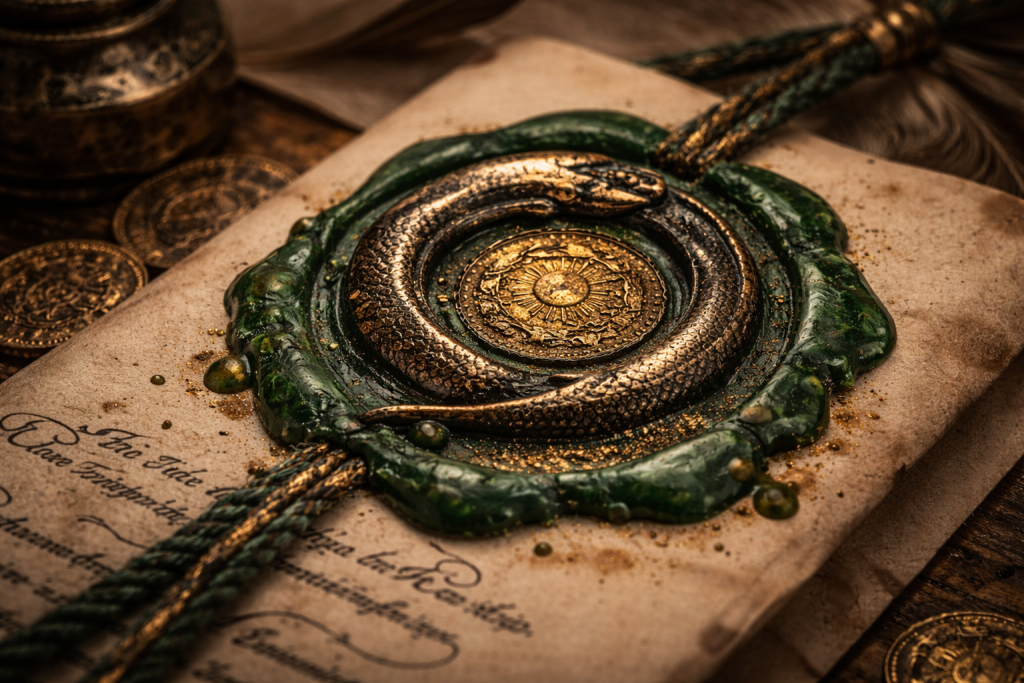
He broke it and read quickly. His eyes moved faster than a scribe’s quill.
“Merrow offers a marriage,” he said.
Halric’s mouth tightened. “To whom?”
“Lady Sabine Merrow,” Joryn replied. “Their second daughter. They propose she be wed to me before the Spring Fair. They also propose… cooperation.”
“Cooperation,” Halric echoed, tasting the word like spoiled wine. “It never arrives without a hook.”
Joryn held the letter out, but Halric did not take it. He stared past it, to the road, to the river, to the far hills where the snow thickened in the air like an oncoming veil.
“What do they want?” Halric asked.
“They want access,” Joryn said quietly. “To the Engine.”
Halric’s laugh was short. “A brass god in a locked room. Let them pray from outside.”
“It isn’t a god,” Joryn said, and the old warning slipped from him as naturally as breath. He barely knew he’d spoken it until his father’s eyes flicked toward him, sharp as a drawn knife.
“What did you say?”
Joryn hesitated. The phrase felt dangerous to say aloud, like naming a sickness.
“AI Winter is coming,” he said softly.
Halric’s expression hardened. “Don’t bring that superstition into my gatehouse.”
“It isn’t superstition,” Joryn insisted, voice low. “It’s… a way of speaking about what’s already happening. It’s what the guild men whisper when they pass the sealed hall. It’s what the merchants mutter when they count coins that don’t buy as much as they did last month.”
Halric turned away as though the snow offended him. “They whisper because they fear. Men always fear what they do not understand.”
“And men die from what they do not understand,” Joryn said.
Halric’s shoulders stiffened. “Mind your tongue. The Engine was bought to help us measure grain, schedule barges, keep ledgers cleaner than the scribes ever could. It is a tool.”
“A tool,” Joryn agreed, “that changes the hands that hold it.”
The keep’s great hall was bright with hearthlight and shadowed banners when Guildmaster Edda Sorn arrived, stamping snow from her boots. She was not noble, but she carried herself with the weight of someone who held the kingdom’s memory in her ink-stained hands.

The Scribes’ Guild of Greyfen had served House Vayne for three centuries. They kept birth records and harvest tallies, wrote contracts, settled disputes with words instead of blood. Their ledger house in the lower ward was as respected as any sept.
Edda bowed to Halric, then looked directly at Joryn. Her eyes were pale and steady, the color of winter sky.
“My lord,” she said to Halric, “we need to speak.”
Halric gestured toward a bench near the fire. “Then speak.”
Edda did not sit. “Your steward dismissed eight of my apprentices this morning.”
Halric frowned. “I dismissed no one.”
“Your steward did,” Edda repeated. “He said their services were no longer required. He offered them each a silver and a loaf of bread. He told them—” her voice tightened “—that the Engine now keeps better count.”
Behind her, in the hall’s edge, scribes in plain cloaks shifted uneasily. Their hands were bare, their ink horns conspicuously absent. They looked like men who had been told to leave their own skins behind.
Halric’s gaze slid to Joryn, then back. “If the Engine can do their work, what would you have me do? Pay for pride?”
Edda’s jaw worked, as if she were biting down on something bitter. “Your house pays for order. Pride is for poets.”
“And yet,” Halric said, “you stand in my hall with your chin high.”
Edda’s eyes did not drop. “Because order is not only numbers. It is judgment. It is memory. It is knowing when a tally is wrong because the man who brought the grain always steals a sack. Your Engine does not know men.”
“It learns patterns,” Joryn said. He hadn’t meant to speak, but Edda’s anger felt like a warning bell.
Edda looked at him sharply. “Does it learn hunger? Does it learn the sound a mother makes when she cannot feed her child? Or the way a desperate man signs anything if you hold his debt over him?”
“My heir,” Halric said, “will not be lectured by a guildmaster.”
Edda turned back to Halric. “Then hear this, my lord. My guild is not merely ink. We are the spine of trade. We certify contracts across the valley. We arbitrate disputes. If we are made irrelevant here, we will take our services elsewhere. House Merrow will welcome us. House Rook—” she spat the name like a curse “—will welcome us with open coffers.”
At the mention of House Rook, a hush fell. Everyone knew of Lord Corvin Rook—quiet, pale, and smiling like a man who never lost at cards because he never played with his own money.
Halric’s mouth tightened. “House Rook is a vulture. It eats what others kill.”
“And the Engine will be the kill,” Edda said.
Joryn felt it then: the fear under her anger. Not fear of the machine itself, but fear of being replaced by something that did not sleep, did not bargain, did not age. Fear of being made into a footnote in someone else’s ledger.
Outside the hall, the snow thickened against the windows, turning the world into blurred shapes. In that muffled silence, Joryn heard the Engine’s distant ticking like a patient heartbeat.
That night, Joryn went to the sealed hall.
Two guards stood at the iron-bound door. They knew him. They stepped aside without question.
The air inside was warmer than the rest of the keep, dry and metallic. The Cognition Engine filled the chamber like a beast built from brass ribs and steel tendons. Great cogs turned behind latticed panels. Ribbons of punched paper fed through its throat. Thin needles flicked and tapped, marking ink in tiny, precise strokes on long parchment scrolls that spilled into baskets like shed skin.
Joryn moved closer, lantern held low.
On the central plate, a dial spun slowly. Around it, etched in old script, were the words the machinists had engraved at the request of the first lord who funded it:
COUNT WHAT CAN BE COUNTED.
WEIGH WHAT CAN BE WEIGHED.
PREDICT WHAT MAY BE PREDICTED.
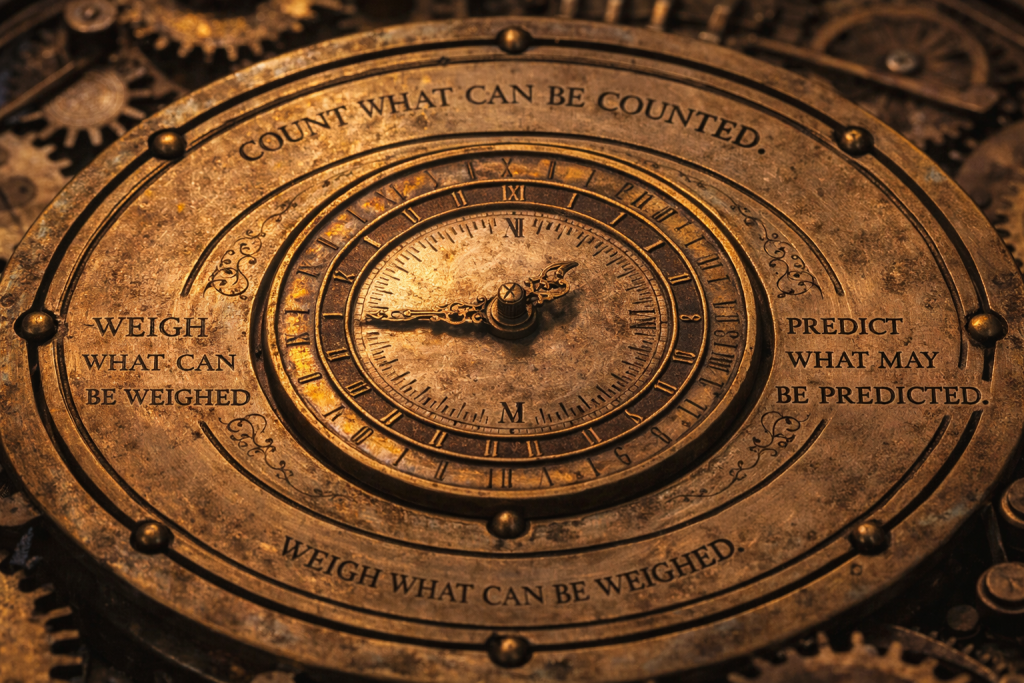
Joryn’s breath fogged in the warmth as he watched a new strip of parchment emerge. It bore columns of figures and symbols. At the top, a heading:
HARVEST FORECAST: LOWER GREYFEN WARD.
PROJECTED YIELD: 14% BELOW AVERAGE.
Below, another heading:
LABOR OPTIMIZATION: SCRIBE HOUSE.
RECOMMENDED REDUCTION: 32%.
It wasn’t cruelty. It wasn’t malice. It was the cold clarity of numbers that did not care who cried.
A voice came from the doorway. “Beautiful, isn’t it?”
Joryn turned. Lord Corvin Rook stepped into the chamber as if he belonged there. He wore a cloak so dark it drank the lanternlight. His smile was polite, almost gentle.
“How did you get past the guards?” Joryn asked.
Corvin’s smile widened slightly. “Guards are men. Men are persuaded.”
“Or bought,” Joryn said.
“Call it what you like,” Corvin replied, moving closer. He didn’t touch the Engine, but he looked at it with the reverence some men reserved for altars. “This is the future. A lord who ignores it will be a lord who begs.”
“My father does not beg,” Joryn said.
Corvin glanced at him. “No. He will bleed quietly. Pride makes for silent deaths.”
Joryn’s hand tightened around his lantern. “Why are you here?”
“To talk,” Corvin said smoothly. “House Vayne sits at the river’s throat. Your barges, your grain, your tolls—Greyfen is a hinge. A clever man would ensure the hinge swings his way.”
“You want the Engine,” Joryn said.
“I want access to its counsel,” Corvin corrected. “As House Merrow does. As the Crown will, eventually. But your father is… sentimental. He thinks old ways are strong simply because they are old.”
Joryn watched the paper ribbon feed through the machine. “And you think new ways are strong simply because they are new.”
Corvin’s eyes flicked to the parchment basket. “Not new. Efficient.”
“You’re here at night because you don’t want my father to know,” Joryn said. “So you want me.”
Corvin’s smile was a soft knife. “I want you to understand the moment you stand in. The valley’s houses are already moving. Merrow offers you a marriage. It is an offer of alliance—of coin, of rivers, of trade. Your father will refuse because he despises debt. House Merrow will then seek another partner.”
“Rook,” Joryn said.
Corvin inclined his head. “Perhaps. Unless you choose otherwise.”
“You speak as if I can decide,” Joryn said.
Corvin stepped closer, lowering his voice. “You can. He is your father. But you are the future of House Vayne. You will inherit his walls, his river, his stubbornness—unless it kills you first.”
The Engine clicked and hissed.
Corvin’s gaze sharpened. “Listen to me, heir. AI Winter is coming.”
Joryn felt the words land like snow on bare skin—cold, inevitable. “You shouldn’t say that,” he murmured.
“Why?” Corvin asked. “Because it frightens you? Good. Fear keeps a man awake.”
Joryn’s eyes drifted to the parchment headings. Reduction. Optimization. Forecast.
“It frightens the guild,” Joryn said. “It frightens my father. And it should frighten you.”
Corvin’s brows lifted. “Me?”
“Yes,” Joryn said softly, and surprised himself with the steadiness in his voice. “Because you think you control this. You think it’s a tool you can wield. But the tool changes the hand.”
Corvin’s smile faded for a heartbeat—just long enough for Joryn to see something like hunger behind it. Then the smile returned.
“Spoken like a thoughtful man,” Corvin said. “Thoughtful men make excellent rulers… if they learn to act.”
Three days later, the Spring Fair emissaries arrived early, their banners snapping in the wind. House Merrow sent a carriage lacquered green and gold, with Lady Sabine inside, wrapped in fur. She was younger than Joryn expected—perhaps sixteen—her eyes sharp, her expression composed with the practiced calm of a girl raised among ledgers and negotiations.
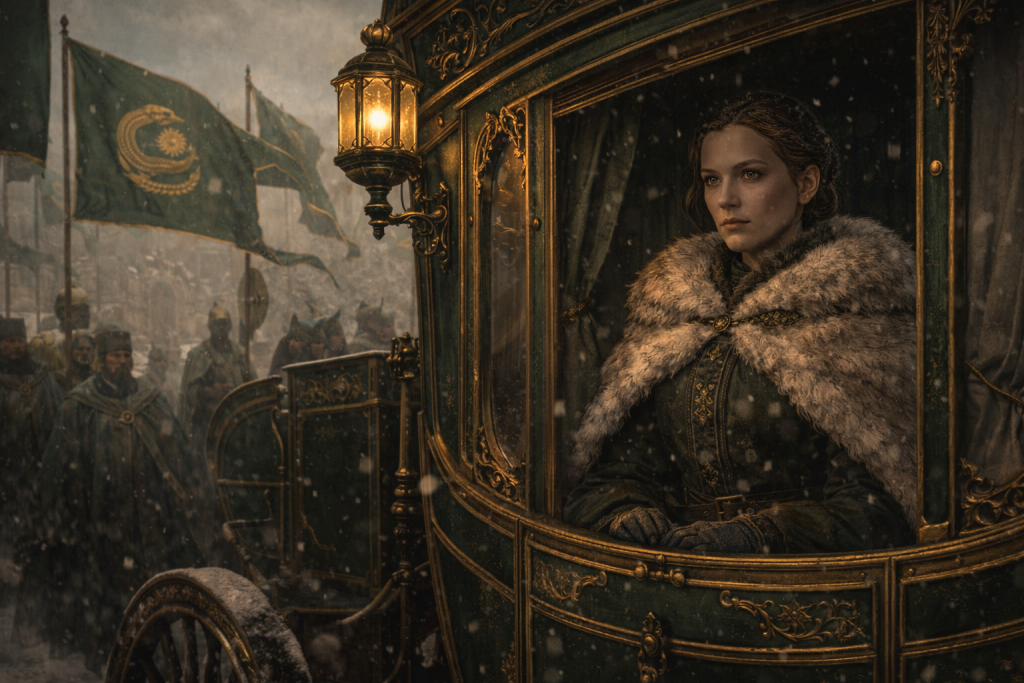
She greeted Halric with a perfect bow, then looked at Joryn as if appraising a shipment.
“My father sends respect,” she said. “And an offer. We will join our houses. We will share river rights. We will bring coin to reinforce your walls and build new docks. In return, we ask for…” her gaze flicked toward the keep’s inner corridors “…cooperation.”
Halric’s jaw set. “You ask for my house’s secrets on the day you step across my threshold.”
Sabine did not flinch. “We ask for mutual survival.”
“Our survival has never depended on Merrow coin,” Halric snapped.
“No,” Sabine agreed calmly. “It has depended on Merrow trade.”
A murmur went through the hall. Halric’s nostrils flared.
Joryn watched, mind racing. He saw Edda Sorn standing near the back, her face like stone. He saw Merrow’s scribes, quiet and tidy, hands already ink-ready. He saw Corvin Rook, leaning against a pillar in shadow, watching like a man at a theater.
He saw the shape of the future in the way everyone avoided looking toward the sealed hall.
Halric spoke at last. “I will not wed my son to a contract.”
Sabine’s eyes sharpened. “You would rather wed him to decline.”
Halric took a step forward. “Choose your words.”
Sabine smiled faintly. “Very well, my lord. Then I will choose the only words that matter.”
She turned slightly, so her voice carried to the whole hall, and spoke as if reciting a proverb older than the valley itself.
“AI Winter is coming.”
The hall went quiet in a way that felt unnatural, as if even the fire had stopped crackling to listen.
Halric’s face flushed with anger. “Enough.”
But the words had already taken root. Joryn saw it in the way the steward’s eyes darted. In the way a guard swallowed. In the way Edda Sorn’s fingers curled as if resisting the urge to grasp a quill that was no longer welcome.
Lady Sabine’s emissary produced a parchment. “My lord, if you will not consider marriage, consider at least a trade charter. We propose a joint council to—”
Halric waved him silent. “No council. No charter. No marriage. Take your coin and your riddles back to Stoneharbor.”
Sabine did not argue. She simply nodded once, with the calm of someone writing down a conclusion.
“As you wish,” she said. “We will find partners who listen.”
When Merrow’s carriage rolled away into the falling snow, the keep felt colder, though the hearth still burned.
That night, the lower ward erupted—not in blood, but in voices. The dismissed scribes gathered outside the ledger house, joined by porters and dock men who had heard rumors that the Engine’s next recommendations would cut their wages, reorganize their shifts, assign labor as if men were interchangeable parts.
Edda Sorn stood on the ledger house steps, cloak pulled tight, speaking to the crowd with a steady voice. “We will not be erased quietly,” she said. “We will not become shadows in someone else’s tally.”
In the keep above, Halric refused to look out.
“They’re frightened,” Joryn told him.
“They’re insolent,” Halric replied.
“They’re both,” Joryn said. “And we’re running out of time.”
Halric turned on him. “You sound like Rook.”
Joryn stiffened. “Rook is a vulture, you said.”
“And you’ve been feeding it,” Halric snapped. “Don’t deny it. He’s been seen in the corridors. He’s been seen near the sealed hall.”
Joryn’s stomach dropped. “He spoke to me. I didn’t invite him.”
Halric’s eyes were hard. “But you listened.”
Joryn tried to steady his voice. “Father, Merrow will ally with Rook. The guild will go with them. Our trade will bleed away. The Engine—”
“The Engine is ours,” Halric said, voice rising. “Ours. We will weather this as we have weathered every storm.”
Joryn looked at him, at the stubborn set of his jaw, at the pride that had kept House Vayne standing for generations—and that might now topple it.
Outside, the crowd’s voices grew louder. Not violent. Just… determined.
A steward entered, pale and sweating. “My lord,” he said, “House Merrow’s emissary left a final message.”
Halric sneered. “Another proverb?”
The steward swallowed. “No, my lord. A notice. They have signed a river charter with House Rook. Effective immediately. All Merrow barges will bypass Greyfen and dock at Blackferry, under Rook protection.”
The words landed like a hammer. Greyfen’s river tolls were its lifeblood.
Halric went still, as if struck.
Joryn felt something in him shift, like a cog catching in place. He saw, suddenly, the whole machine of power: not brass and steel, but alliances and contracts, fear and adaptation. He understood what the Engine could calculate—what it could not. It could predict yields and optimize labor, but it could not predict pride.
“You should have listened,” Joryn said quietly.
Halric’s voice was a rasp. “Get out.”
Joryn didn’t move. “Father—”
“Get out,” Halric repeated, louder now, and for a moment he looked not like a lord but like an old man staring at the end of his own story.
Joryn left.
He went to the sealed hall.
The guards were gone.
Inside, the Cognition Engine ticked steadily in the warm, metallic air. Parchment spilled in fresh ribbons. Joryn lifted one and read, heart sinking.
RIVER TOLL FORECAST: HOUSE VAYNE.
PROJECTED LOSS: 61%.
FORTIFICATION RECOMMENDATION:
REDUCE EXPENDITURE. PRIORITIZE LIQUID ASSETS.
POLITICAL STABILITY:
RISK OF INTERNAL UNREST: HIGH.
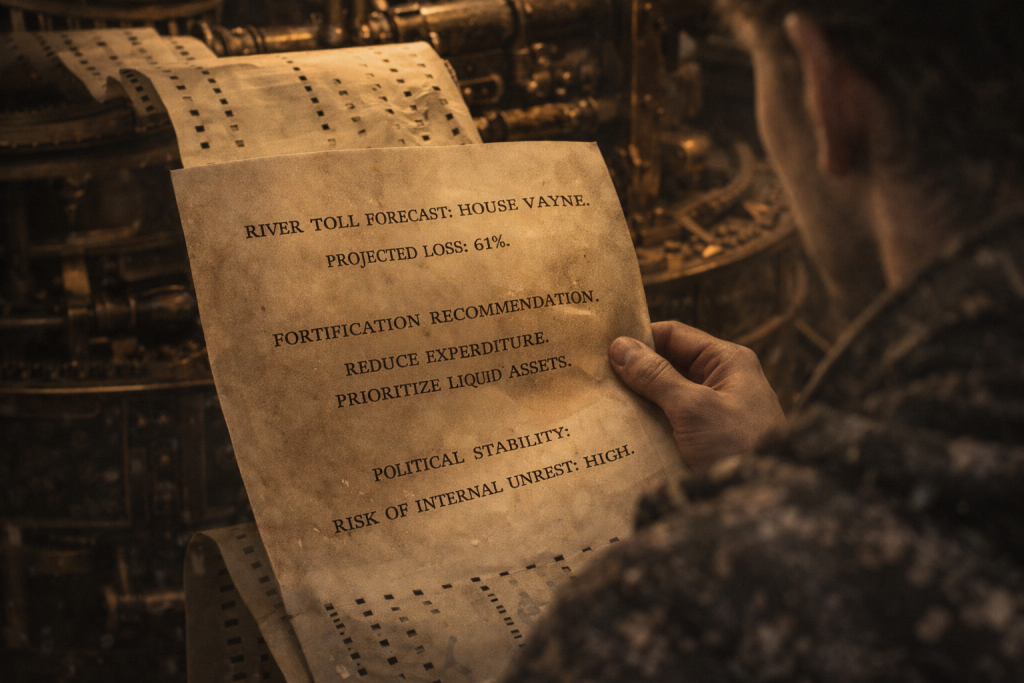
He heard footsteps behind him and turned. Edda Sorn stood in the doorway, her face pale, eyes bright with something like grief.
“I knew you’d come here,” she said.
Joryn’s throat tightened. “They’re going to dissolve your guild.”
Edda’s lips pressed together. “They already have. Not with a decree. With a calculation.”
Joryn looked at the machine. “I can stop it.”
Edda laughed softly, not unkindly. “Can you? Or can you only decide who holds it?”
Joryn didn’t answer.
Edda stepped closer and lowered her voice. “Lord Rook visited me. Offered protection. Offered my guild a place under his banner. He says he will keep scribes employed—” her eyes narrowed “—as long as we certify his contracts and keep our mouths shut.”
Joryn’s hands clenched. “And will you?”
Edda’s gaze held his. “My people need bread. Pride does not fill bellies.”
He felt the tragedy forming, inevitable as snowfall.
“What do you want from me?” he asked.
Edda’s voice softened. “I want you to remember this moment when you inherit whatever is left. The Engine does not hate us. It simply does not need us. The only question is whether you will build something new—or cling to what was.”
Joryn’s eyes stung, though he did not let tears fall. “My father won’t bend.”
Edda nodded once. “Then he will break.”
By dawn, it happened quietly.
House Vayne’s steward announced austerity measures. Guards’ wages were cut. Dock men were reassigned. The Scribes’ Guild charter was revoked “pending review.” Merrow barges bypassed Greyfen, their lanterns a distant line on the river like a procession of ghosts.
Lord Halric stayed in his chambers, refusing council, refusing visitors. He did not speak to his son again.
Two weeks later, a sealed letter arrived bearing the Crown’s stamp.
House Vayne, it said, would be placed under “temporary oversight” to ensure stability along the river trade route. A Crown-appointed administrator would manage tolls and trade until further notice.
It was not exile in chains. It was something worse: a polite removal, a loss of sovereignty wrapped in formal language.
In the great hall, Halric stood beneath his banner and read the letter aloud, his voice steady until the last line.
Then his hand trembled.
No one cheered. No one protested. They simply absorbed it, as people do when they realize the world has moved without asking them.

Joryn watched his father fold the letter carefully, as if folding could undo it.
That night, Joryn walked the battlements alone. Snow fell in slow, soft sheets, blurring the valley into a single pale breath.
Below, in the lower ward, lanterns flickered in the ledger house. Edda’s guild had returned—not as a power, but as employees under new contracts signed in Blackferry ink.
Somewhere beyond the river, House Rook’s banners rose.
Behind Joryn, deep in the keep, the Cognition Engine ticked and breathed, indifferent and tireless.
He pulled his cloak tighter against the cold and whispered the words that now felt less like warning and more like weather.
“AI Winter is coming.”
The ideas behind this piece didn’t come out of nowhere. They’ve been forming through the content I’ve been consuming lately — economics, geography, technology, history, and self-help.
Here’s what’s been shaping my thinking:
- Article: The Adolescence of Technology by Dario Amodei
- Article: Machines of Loving Grace by Dario Amodei
- Article: Is ChatGPT 5.0 the Start of the AI Winter?
- Article: Microsoft AI chief gives it 18 months—for all white-collar work to be automated by AI
- Article: AI writes the code now. What’s left for software engineers?
- Article: Why AI might strain the economy before it booms
- TikToc: Great Summary of AI by Stay_Human25
- Book: When the Clock Broke by John Ganz
- Article: 4 Expert Habits to Keep a Calm Mind
- Article: How to Sleep Well and Wake Up Energized in 2026
Discover more from The Blog of Josh
Subscribe to get the latest posts sent to your email.